
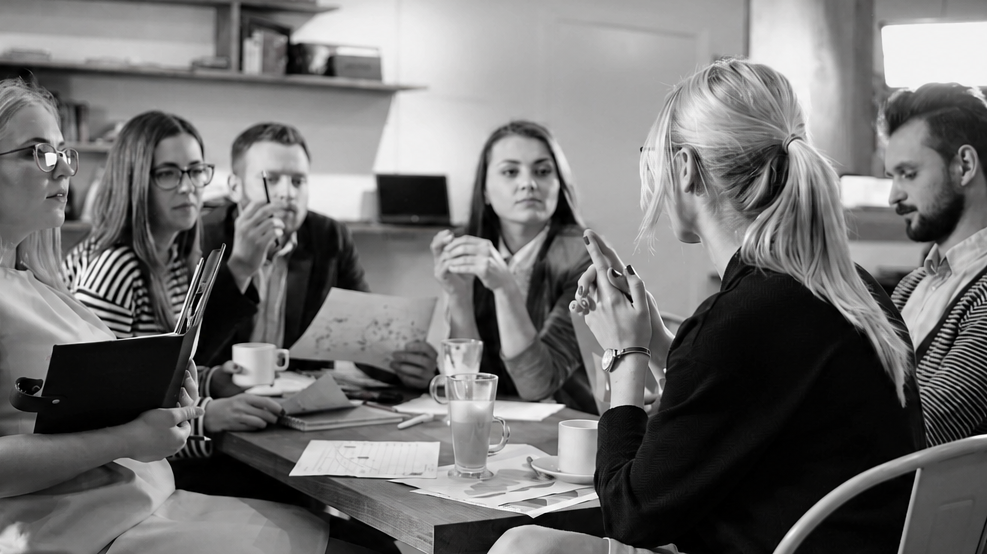
What's going on in the room?
Whenever we come together to work on something, there is more going on — and shaping the work — than just the conversation we can hear. Learning to notice more of it can improve the way we work together
We’ve all been in meetings where something doesn’t seem quite right. The conversation seems reasonable enough, but someone who knows a lot about the issue has barely spoken; two people seem to be disagreeing without talking about quite the same thing; or somebody raises an important concern which somehow disappears.
So we can find ourselves wondering: what’s going on here?
We spend a lot of our working lives trying to get things done with other people — making decisions, solving problems, developing strategy, navigating change. Our focus is on the content. But there is also the group’s process and the group dynamics shaping what is said, heard and acted on.
This article looks at some of what may be happening beneath and around the visible conversation. It begins with four interacting levels — individual, interpersonal, group and organisational — then considers sensemaking, how groups use knowledge, who gets heard, what doesn’t get said, and what happens when difference and disagreement enter the conversation.
The later sections turn to a caution that runs through all of this: seeing is not knowing.
The particular role of the facilitator is also discussed, and the part all of us play in creating group process. The article then finishes with some practical ways of working with what we notice.
There is more going on than we can see
There is plenty going on in a room beyond the visible conversation. Each of us brings different perspectives. Relationships, authority, expertise and status matter; so do judgements about what can safely be said and whether speaking will make any difference. And the organisation is in the room too. One useful way of making this complexity more manageable is to think in terms of four interacting levels.
At the individual level, we bring different expertise, identities, goals, assumptions and emotional states. Our attention is limited and, under pressure, we may simplify. But we should be cautious about inferring someone’s inner state from a posture, facial expression or isolated comment, or explaining behaviour mainly in terms of personal disposition while overlooking situational conditions (Ross, 1977; Malle, 2006).
At the interpersonal level, relationships and histories matter. Trust, status and expectations shape the meaning of exchanges. The same direct question may be welcome candour in one relationship and a challenge to authority in another; a disagreement may also carry the residue of previous interactions.
At the group level, patterns emerge through interaction. Norms develop about who speaks, what evidence counts, and how disagreement is handled. Informal roles develop; some interpretations gain traction and others disappear. Cohesion can support commitment but doesn’t guarantee good judgement, and group development doesn’t follow one simple, fixed sequence (Tuckman, 1965; Gersick, 1988).
At the organisational or systemic level, structures, roles, workload, technology and professional boundaries constrain and enable behaviour. An apparent communication problem between two people may involve incompatible objectives or unclear responsibilities. Treating a system-produced conflict purely as a relationship problem can ask individuals to solve conditions outside their authority. But ‘the system’ can also become an abstraction that removes agency.
So a process question is not simply, ‘Is this a people problem or a system problem?’ but, ‘What’s happening here, and what can we actually influence?’ The four levels continuously affect one another, and everyone in the room — including the facilitator — is inside this system.
Figure 1. Four interacting levels in the room
Level | What may be operating | What may become visible |
Individual | Attention, identity, goals, affect, expertise, assumptions, load | Interpretations, choices, speech, silence |
Interpersonal | Trust, attribution, reciprocity, status, authority, history | Challenge, support, interruption, repair |
Group | Norms, roles, coalitions, shared models, information pooling, decision rules | Participation, convergence, conflict, coordination, learning |
Organisational / systemic | Structure, resources, history, regulation, intergroup relations | Constraints, consequences, authorised knowledge, delegations |
Looking across these levels raises another question. If we are all situated differently within this interacting field, should we expect to understand what is happening in the same way? Well probably not. Our position affects the information we encounter, the pressures we carry and what consequences matter to us; our experience, relationships and assumptions affect what we notice and the significance we give it.
The four levels therefore do more than help explain behaviour. They also help explain why we can interpret the same situation differently. We participate in the field from different positions, notice different cues and construct accounts that influence what we say and do. Those actions then become part of the situation everyone else must interpret. This brings us to sensemaking.
Making sense of what is happening
Groups do not simply encounter an objective situation and then decide what to do. We notice different cues, connect them with different histories and construct different accounts of what is happening. Imagine an organisation considering a significant change. The CEO sees a necessary response to funding pressures; an operations manager sees a difficult implementation problem; a frontline practitioner sees risks to service quality; and someone who has lived through several restructures sees another initiative that may disappear when the next priority arrives. They are discussing the same change, but not quite the same thing.
Karl Weick used the term sensemaking to describe how people construct workable understandings of situations that are uncertain or ambiguous (Weick, 1995; Weick, Sutcliffe and Obstfeld, 2005). This is not a claim that facts do not matter or that every interpretation is equally sound. It is a reminder that we notice selectively, interpret through experience and identity, and act on the accounts we form. Those actions then alter the situation we are trying to understand.
This matters particularly when the situation is changing, incomplete or open to interpretation. By the time disagreement becomes visible, we may already have constructed quite different versions of what is going on.
It poses the question:
Are we disagreeing about what to do — or are we disagreeing about what is happening?
Before trying to resolve the disagreement, it can help to find out how we each understand the situation: what problem we think we are solving, what we are seeing from where we sit, and what others may see differently. The aim is not necessarily to get everyone ‘on the same page’. What matters is enough shared understanding to work together, with enough room for differences to remain visible.
Those different vantage points also mean that knowledge is distributed. We may understand different parts of the situation because of where we sit, what we do and what we have experienced. The next question, then, is whether the group can actually get access to what its members know.
What gets heard?
Put the right people in a room and collectively they are likely to know a lot about the situation. But having that knowledge present is not the same as making it available to the group.
Research into group decision-making has found that groups tend to spend more time discussing information already shared by several members than information held by only one or two. Stasser and Titus showed that groups could fail to identify the best choice even when they collectively possessed the necessary information (Stasser and Titus, 1985). A later meta-analysis linked information sharing with team performance, especially when the information was unique (Mesmer-Magnus and DeChurch, 2009).
The problem is not simply whether the right expertise is represented. Groups have to surface, recognise and use what different members know, especially in complex work where knowledge is distributed across roles, professions or parts of an organisation.
We see versions of this all the time. A management team spends a lot of time on a strategic rationale everyone already knows. An operational manager raises an implementation concern and nobody picks it up. Ten minutes later, a more senior person raises essentially the same issue and suddenly it matters.
Participation is not the same as information use.
The interesting questions are not only about who speaks. Who knows something? Does it get said? Does anyone notice it? What happens after it is said? Which ideas are explored, which disappear, and whose knowledge needs to be repeated by someone else before it gains credibility? A group can be highly participative and still make poor use of what it knows.
Good process therefore matters to the quality of the group’s thinking, not simply to whether a meeting feels inclusive. But there can be another problem: some relevant knowledge, concerns and doubts never enter the conversation at all.
What doesn’t get said
Some information never becomes available to the group. We judge whether we can say something, whether we should, whether it will make any difference and what might happen if we do. Silence can arise from fear, futility, uncertainty, deference to expertise, protection of relationships or judgements about authority and relevance (Morrison, 2023).
Psychological safety is important. We are more likely to speak, ask for help, acknowledge mistakes or raise concerns when we believe we can take interpersonal risks without being punished or humiliated (Edmondson, 1999; Frazier et al., 2017).
Rather than interpreting silence for someone, we can create better opportunities for contribution and inquire. A facilitator might pause, invite views not yet heard or ask whether there is information the group has not considered. Other members can return to an overlooked concern, ask a quieter colleague what they are seeing, or simply leave more room before filling the silence.
Power is also part of the picture. Asking for everyone’s opinion doesn’t remove differences in authority, status or influence. A CEO can genuinely invite disagreement, but we still know who the CEO is. We read those differences and decide how much to say and how directly to say it.
Argyris and Schön’s distinction between espoused theory and theory-in-use is useful here. We may sincerely say that our group welcomes challenge while repeatedly responding to challenge in ways that make us less likely to offer it next time (Argyris and Schön, 1974; Argyris, 1990). What the group actually rewards, ignores or punishes is what matters – not what it espouses.
Participation, voice, influence and decision-making power therefore need to be distinguished. Being invited into the room is not the same as having our knowledge taken seriously, and being listened to is not necessarily the same as having a say in the final decision. Clarity about those differences can make conversations more honest and difference more usable.
Difference can help — and hinder
Difference is necessary for good collaboration. Bringing a group together has little value if everyone contributes the same information and perspective. But difference is not automatically productive. It can expand what the group can see, while also activating identity, status, defensiveness and conflict.
Research distinguishes task, relationship and process conflict. Relationship and process conflict generally impair performance; task conflict is more conditional and can readily become personal (De Dreu and Weingart, 2003; De Wit, Greer and Jehn, 2012). Diversity creates informational potential rather than guaranteed performance, while minority dissent can stimulate divergent thinking under the right conditions (Nemeth, 1986; van Knippenberg, De Dreu and Homan, 2004).
The practical aim is therefore neither harmony nor manufactured conflict, but usable difference: conditions in which challenge is legitimate, reasons and evidence can be examined, uncertainty can be acknowledged and relationships can be protected without suppressing substantive disagreement.
Emotion is also obviously part of this. Emotion can influence attention, judgement and coordination. But simple accounts of automatic ’emotional contagion’ go too far: people interpret the expresser and situation and may converge, diverge or regulate what they display (Barsade, 2002; Elfenbein, 2014). Acute stress can also affect decision-making, although effects vary (Starcke and Brand, 2016).
Groups can also develop patterns that no one person appears to have designed. A group may repeatedly avoid a difficult issue, fall into familiar patterns of disagreement or become unusually agreeable. Groupthink is a useful warning about concurrence-seeking, although evidence for a single reliable syndrome is mixed (Esser, 1998).
The point is not to put a name on every pattern. It is to notice when difference is being made useful, when it is becoming destructive, and when the group may be organising itself in ways that make inquiry harder. That brings us to an important caution about all the concepts in this article.
Seeing is not knowing
As we learn more about group dynamics, a particular danger appears: we can become very good at explaining everybody else. Silence becomes resistance; agreement becomes groupthink; tension becomes low psychological safety. Concepts intended to enlarge understanding can instead close inquiry.
The central distinction is between observation and explanation. For example, ‘Three people have not spoken’ is an observation. ‘They are disengaged’ is an interpretation. ‘Each time an implementation concern is raised, we return to the strategic case’ stays relatively close to what happened. ‘We are avoiding implementation’ moves into explanation. Interpretations are unavoidable and often useful, but they are better held as hypotheses than facts.
The distinction between noticing and making meaning is especially important. Noticing should stay reasonably close to what we can observe: what was said, who spoke, what happened next, what seemed to be repeated or left aside. Making meaning is the interpretation we place on those observations — our attempt to explain what they might mean.
We are constantly making meaning, making sense of what is happening. The important thing is to remember that the meaning we make is an interpretation, not the observation itself. Holding that interpretation lightly leaves room for other explanations and for other people to see the situation differently. Hearing different perspectives therefore guards against premature certainty. Schein’s work on process consultation and inquiry similarly reminds us to remain curious about another person’s reality rather than assume we already understand it (Schein, 1999; 2009).
The deeper point is simple:
Knowledge of group dynamics should expand the range of explanations available to us, not increase our certainty that the first explanation that occurs to us is true.
We are all part of what is happening
None of us is an observer standing outside the process. A question, silence, joke, summary, challenge or expression of scepticism becomes part of what happens next.
This is particularly apparent for facilitators because they exercise process authority. What they ask, whom they invite to speak, what they summarise and when they move on all shape the group. Their own reactions are also data, but not proof of what is happening inside anyone else (Schein, 1999).
But all group members help create the process. Asking whether we are actually discussing the same problem, returning to an overlooked contribution, acknowledging uncertainty, dismissing a concern or automatically deferring to authority can all alter what becomes possible. This shifts group dynamics from a spectator’s perspective to a participative one: What am I doing here, what effect might that be having, and what could I do differently?
Once we see ourselves as part of the process, the practical question changes. We don’t need to stand outside the group and diagnose it. We need ways of noticing and responding that help the group learn more about what is happening while it continues to do its real work.
Notice more. Assume less. Ask better questions.
So what do we do with all this? It is not about turning every meeting into a discussion about group dynamics. Process matters when attending to it helps the group do its work better. One way of doing this is to notice more, assume less, ask better questions, act proportionately and learn from what happens.
We can notice more: not only what we say, but what happens to it. Whether we seem to be solving the same problem. Whose knowledge shapes the discussion. What seems difficult to talk about. Whether something that looks interpersonal might also involve roles, structures or competing expectations.
We can assume less, keeping some distance between what we observe and the explanation we give it. Instead of deciding that someone is resistant, disengaged or defensive, we can treat that as one possibility among several.
And we can ask better questions. What problem do we each think we are trying to solve? What are we assuming? What information have we not heard yet? What might somebody who disagrees with us say? What is fixed and what is genuinely open? What happens to this decision when it meets the reality of the work?
Sometimes we can make an observation available: ‘Each time one of us raises an implementation concern, we return quite quickly to explaining the strategic case. Do we need to stay with the implementation question?’ That differs from saying, ‘We’re avoiding the implementation issues.’ One offers something to examine together; the other supplies the explanation before we have had the chance to find out.
We can also act on what we notice: pause before deciding, ask everyone to think independently, invite a view not yet heard, clarify decision authority, or return to a question repeatedly pushed aside. The intervention need not be elaborate; often the useful move is simply the one that helps us see or hear something that was not available a moment earlier.
Then we see what happens. Perhaps the question opens something useful. Perhaps the group rejects the observation. Perhaps a completely different explanation emerges. Whatever happens gives us new information. We notice, make meaning, act, notice what happens and revise. That is the recursive logic of action research: learning about how we are working while the work itself unfolds (Lewin, 1946; Dick, 1993).
Understanding group process doesn’t replace the real work of the group. Strategies still need to be developed, decisions made, service problems addressed and changes worked through. Expertise, evidence and accountability still matter. What changes is what we become capable of noticing while doing that work.
We can attend both to the task and to how we are approaching it: consider explanations at different levels, ask whether we are constructing the situation differently, notice whose knowledge becomes available, attend to power and the consequences of speaking, and include our own contribution in what we are trying to understand.
The facilitator has a distinctive responsibility for purpose, participation, process and the conditions under which the group works. That person may be a manager, project lead, team member or external facilitator. But the facilitator is not the sole owner of the group’s process, nor the rest of the group passive recipients of good facilitation. Effective group membership is itself a practice, and everyone can lead.
Perhaps that is the most useful way to think about what is going on in the room:
The aim is not to become increasingly confident in our ability to read other people. It is to become more capable of noticing what might be happening, more curious about explanations other than our own, and better able to help the group find out together.
References
Argyris, C. (1990) Overcoming Organizational Defenses: Facilitating Organizational Learning. Boston, MA: Allyn and Bacon.
Argyris, C. and Schön, D.A. (1974) Theory in Practice: Increasing Professional Effectiveness. San Francisco, CA: Jossey-Bass.
Barsade, S.G. (2002) ‘The ripple effect: emotional contagion and its influence on group behavior’, Administrative Science Quarterly, 47(4), pp. 644–675. doi:10.2307/3094912.
De Dreu, C.K.W. and Weingart, L.R. (2003) ‘Task versus relationship conflict, team performance, and team member satisfaction: a meta-analysis’, Journal of Applied Psychology, 88(4), pp. 741–749. doi:10.1037/0021-9010.88.4.741.
De Wit, F.R.C., Greer, L.L. and Jehn, K.A. (2012) ‘The paradox of intragroup conflict: a meta-analysis’, Journal of Applied Psychology, 97(2), pp. 360–390. doi:10.1037/a0024844.
Dick, B. (1993) You Want to Do an Action Research Thesis? Chapel Hill, Qld: Interchange.
Edmondson, A.C. (1999) ‘Psychological safety and learning behavior in work teams’, Administrative Science Quarterly, 44(2), pp. 350–383. doi:10.2307/2666999.
Elfenbein, H.A. (2014) ‘The many faces of emotional contagion’, Organizational Psychology Review, 4(4), pp. 326–362. doi:10.1177/2041386614542889.
Esser, J.K. (1998) ‘Alive and well after 25 years: a review of groupthink research’, Organizational Behavior and Human Decision Processes, 73(2–3), pp. 116–141. doi:10.1006/obhd.1998.2758.
Frazier, M.L., Fainshmidt, S., Klinger, R.L., Pezeshkan, A. and Vracheva, V. (2017) ‘Psychological safety: a meta-analytic review and extension’, Personnel Psychology, 70(1), pp. 113–165. doi:10.1111/peps.12183.
Gersick, C.J.G. (1988) ‘Time and transition in work teams: toward a new model of group development’, Academy of Management Journal, 31(1), pp. 9–41. doi:10.2307/256496.
Lewin, K. (1946) ‘Action research and minority problems’, Journal of Social Issues, 2(4), pp. 34–46. doi:10.1111/j.1540-4560.1946.tb02295.x.
Malle, B.F. (2006) ‘The actor-observer asymmetry in attribution: a (surprising) meta-analysis’, Psychological Bulletin, 132(6), pp. 895–919. doi:10.1037/0033-2909.132.6.895.
Mesmer-Magnus, J.R. and DeChurch, L.A. (2009) ‘Information sharing and team performance: a meta-analysis’, Journal of Applied Psychology, 94(2), pp. 535–546. doi:10.1037/a0013773.
Morrison, E.W. (2023) ‘Employee voice and silence: taking stock a decade later’, Annual Review of Organizational Psychology and Organizational Behavior, 10, pp. 79–107. doi:10.1146/annurev-orgpsych-120920-054654.
Nemeth, C.J. (1986) ‘Differential contributions of majority and minority influence’, Psychological Review, 93(1), pp. 23–32. doi:10.1037/0033-295X.93.1.23.
Ross, L. (1977) ‘The intuitive psychologist and his shortcomings: distortions in the attribution process’, in Berkowitz, L. (ed.) Advances in Experimental Social Psychology. Vol. 10. New York: Academic Press, pp. 173–220.
Schein, E.H. (1999) Process Consultation Revisited: Building the Helping Relationship. Reading, MA: Addison-Wesley.
Schein, E.H. (2009) Helping: How to Offer, Give, and Receive Help. San Francisco, CA: Berrett-Koehler.
Starcke, K. and Brand, M. (2016) ‘Effects of stress on decisions under uncertainty: a meta-analysis’, Psychological Bulletin, 142(9), pp. 909–933. doi:10.1037/bul0000060.
Stasser, G. and Titus, W. (1985) ‘Pooling of unshared information in group decision making: biased information sampling during discussion’, Journal of Personality and Social Psychology, 48(6), pp. 1467–1478. doi:10.1037/0022-3514.48.6.1467.
Tuckman, B.W. (1965) ‘Developmental sequence in small groups’, Psychological Bulletin, 63(6), pp. 384–399. doi:10.1037/h0022100.
van Knippenberg, D., De Dreu, C.K.W. and Homan, A.C. (2004) ‘Work group diversity and group performance: an integrative model and research agenda’, Journal of Applied Psychology, 89(6), pp. 1008–1022. doi:10.1037/0021-9010.89.6.1008.
Weick, K.E. (1995) Sensemaking in Organizations. Thousand Oaks, CA: Sage.
Weick, K.E., Sutcliffe, K.M. and Obstfeld, D. (2005) ‘Organizing and the process of sensemaking’, Organization Science, 16(4), pp. 409–421. doi:10.1287/orsc.1050.0133.
Let's work together
If you're facing a challenge that requires people to think together, make sense of uncertainty and find a way forward, let's chat about how I can help.